
Historical—Cowichan Valley Garden
Reprinted from JARS v47n3 - Moonridge: A Mountaintop Garden
MOONRIDGE: A MOUNTAINTOP GARDEN
Leslie Drew
Duncan, British Columbia, Canada
Edited, by Verna Buhler, to be read in the past tense, as this garden, unfortunately, no longer, existsJust north of Victoria on the craggy Malahat, noted for panoramic scenery and arbutus trees, a third-generation Vancouver Islander reached into his back pocket and found enough money to buy a mountain. He laid out a subdivision of the sort where quality mattered most. For a long time, it looked as if he'd lose his plaid shirt. In the economic downturn of the early 1980s, the 10-acre lots sat unsold while costs went into space orbit.
David E. Dougan, though, always gamble[d] to win; he never walk[ed] away from a fight. He waited, as a logger often has to wait for weather to change. While waiting, having boundless energy, he exercised the developer's right to first choice of a lot for himself. Instead of sea frontage, he chose one of the loftiest sites - the only one whose view encompasse[d] snowy peaks of the Olympic mountains far off to the right, and the mainland Coast Range far off to the left, as well as blue waters of the inlet 900 feet below. Here he had a West Coast contemporary-style house built for himself and his wife Lurana ("Lucy" to Dave). They named the place Moonridge.
At first, he didn't intend to make much of a garden; given the splendor of rock outcrops and arbutus, a few primulas would be enough. That was 12 years [before this feature article was written]. [At that time,] the Dougan garden [was] generally regarded as being close to the pinnacle of small private rhododendron gardens, perhaps at the very top.
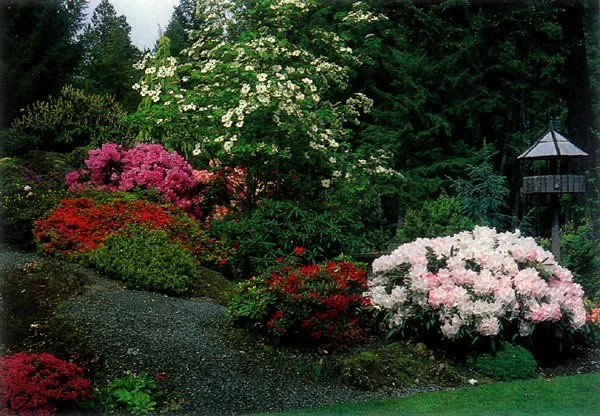
Dougan garden on Malahat mountain
Photo by Bill Dale
Every springtime during [those] years - 1992 especially - this garden [. . .] amazed wave upon wave of tour groups of the American Rhododendron Society. The far horizons [gave] an illusion of endless space to what [was] actually less than an acre. Almost the entire garden [could] in fact, be scanned from a central position. [Guests looked] on, hypnotized, as if walking in a dream [that they hoped would continue forever] Still entranced, viewers turn[ed] to the two prime features: a massive mound of solid rock where rhododendrons [grew] in pockets in ascending heights, and beneath, an adjacent pond, long and deep, rippling as schools of fish stream[ed] along, streaking scarlet. A curving lawn link[ed] bluff, pond, and borders.
[Then] in closer focus, [came] what really [astonished]: the rhododendrons themselves brimming health and deftly arranged. "A garden is rare that covers such a wide range of rhododendrons so well cared for," [said] Bob Rhodes, hybridizer and medical doctor. Other commentators hint[ed] at more abstract qualities. ("I should be encouraged to go home and do better with my own garden," an artist member of the groups [said], "but instead I'm totally discouraged." Dave, quick both to take and make jokes, burst into laughter.) When all the compliments ha[d] been uttered, when the last guests reluctantly wander[ed] off, Moonridge [fell] silent and the garden regain[ed] its essential intimacy. The Dougans [sat] back to watch the late show by moonlight. The garden [was] hauntingly beautiful, even more mysterious.
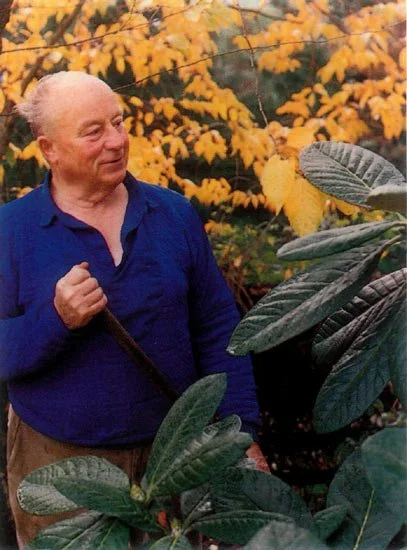
Dave Dougan with 30-year-old Rhododendron praestans. Photo by Bill Dale
An element of mystery, we all know, surrounds any major work of art. Even on an outsize canvas, while the composition and most techniques can be clearly discerned, there remains something beyond comprehension which seems wrapped in a deeper enigma - the artist's own uniqueness - which, in Dave Dougan's case, [was] also full of paradox. A short, stocky man with determination in his stride, he [hadn't] a shred of formal training in horticulture. Like many a lad growing up in the Great Depression, he never went beyond grade eight in school. He [wasn’t] a propagator, never [had] been, yet [knew] the pedigrees of hundreds of rhododendron hybrids. He prize[d] the garden-building efforts of "ambitious, hands-on" amateurs over those of academics. And he detest[ed] formality, which his garden reflect[ed].
Naturalness is often cited as the garden's great charm, but the same can be said of many gardens, the difference here being that the inspiration came from still higher places, from memory of exhilarating alpine landscapes he roamed in younger days. This, more than anything else, informed his vision of what the garden should look like. The pool was conceived as a crystal tarn ("those little alpine pools look so beautiful"). In the translation, achieved in subtle ways, lies much of the garden's fascination for everyone, outdoors people particularly.
"I knew this was a glorious piece of land; old Mother Nature didn't short this one," he continue[d], enthusiasm rising in his voice. "The only disadvantage was it had absolutely no soil. However, I did have an outside source of swamp muck. So, after a bulldozer took out the Douglas firs, I had hundreds of loads of topsoil and sedge peat delivered, and all of this I hand-wheeled to make a planting ramp for the rock mound and a good base for the lawn and other beds.” (His wheelbarrow, which he also trundled over his two previous gardens, deserve[d] bronzing, he [said] in jest, like his logging boots by the fireplace.) At the same time, he planted several rhododendrons carried forward from his earlier gardens supplemented by Japanese maples, dogwood varieties, a Magnolia x loebneri 'Leonard Messel', a deodar cedar, a Cedrus atlantica 'Glauca', and a small Sequoia gigantea which, to his astonishment, [became] 40 feet tall.
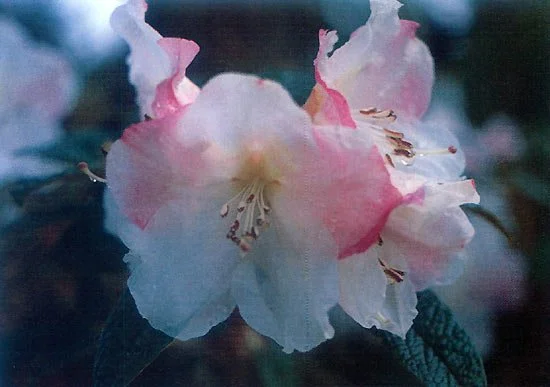
Rhododendron edgeworthii, grown in a tub and wintered in a greenhouse.
Photo by Bill Dale
Money alone, therefore, didn't build this garden; Dave Dougan expended his own physical labor on a herculean scale. At age 71, he still work[ed] four hours on most days, weeding, shifting rhododendrons, and as many as six hours a day before and during the rhododendron season. Lurana, when she [wasn't] looking after their grandchildren or porcelain painting, [was] always ready to entertain and to lend a hand in troublesome weather. Since southeastern Vancouver Island, lying in the Olympics rain shadow, can sizzle in summer, he relie[d] mightily on his automatic watering system (fed from a deep well serving the subdivision) which every week supplie[d] 3,000 gallons in a three-hour period to six garden sectors each with five heads, either standpipes or lawn pop-ups, in rotation. Even so, anxious not to waste water, he often water[ed] his plants by hand. "Rhododendrons wouldn't survive here otherwise," he [said] matter-of-factly. "If this garden were left for a year, I doubt that 10 percent of the plants would still be alive."
For a visual person, Dave Dougan talk[ed] a lot about blind luck. Or dumb luck. He came by his huge R. pseudochrysanthum by "blind luck" nearly 30 years [before]. The way he met an early mentor was blind luck again. Except for the dimensions of the 50-foot-long pool, which had to be proportionate to the dramatic rock bluff, the phases of his garden, so he claim[ed], resulted less from design than from "dumb luck." He [was] not talking blarney from his Protestant Irish background, nor [was] it false modesty, for he [was] proud of his accomplishments. Rather, he seem[ed] to be saying that one cannot be sure of anything in this changing world, least of all steady success in rhododendron gardening. What he [did] say with certainty [was] this: "In their variety of flower, foliage and form, rhododendrons are the loveliest of all the shrubs and trees that we can grow here." From this firm belief flow[ed] his devotion to the genus and by extension to the ARS.
Significantly, he started young. "When I was a little kid, I had a garden of sorts. My mother was a gardener, and although she had eight kids and I was the only one who did this, I'd go out into the bush and bring back little plants such as the rattlesnake plantain and put them in my own little square. Later, at 14, I joined my dad and my older brothers in their logging ventures; what an opportunity that was to learn about plants! After work, I'd go into the mountains, look at the wonderful scenery, notice plants - and animals and birds and insects - and try to figure out where they liked to live, how they interacted." He was, in fact, studying ecology.
"Then, when we were living at Cowichan Bay (10 miles north of the Malahat, in gentler terrain) Lucy got me a book from England, Flowering Shrubs and Small Trees by Norman Catchpole. It was a real bible to me; it had a whole chapter on rhododendrons. Next, somebody told us about Mary and Ted Greig (later ARS Gold Medalists) and their nursery at Royston. Mary was a very cut-and-dried person, but for some reason she took a liking to me, and loaned us her precious tomes - writings by the great plant hunters like George Forrest and Frank Kingdon Ward.
The Greigs had whole greenhouses full of exotic rhododendrons such as R. bullatums and R. lindleyi, and if you happened to be there in March, when these plants were in bloom, you couldn't help but become an enthusiast. They had an amazing number of species from the Buchanan Simpson collection which they'd bought in the 1930s and stuff they'd imported from the Sunningdale Nursery in England, damn good things like the so-called Greig form of strigillosum and big calophytums; that one over there (pointing to a corner of the garden) doesn't touch theirs."
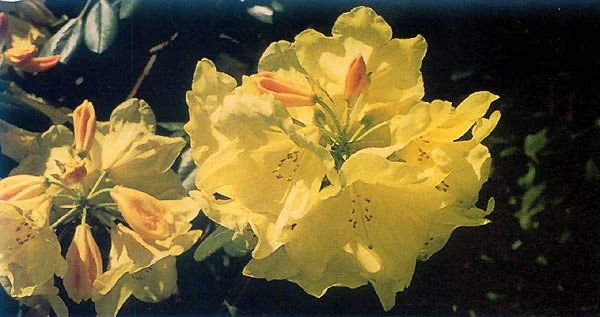
'Crest'
Photo by Bill Dale
The bright young man was learning fast in a wilderness almost bereft of guides, for few gardeners around here grew species. He learned, too, with similarly fired-up friends like Peter and Pat Stone, who were starting their exceptional garden on Quamichan Lake; he learned from visits to the Layritz Nursery in Victoria, stocked with the latest British hybrids but also with species like R. thomsonii and R. falconeri; he learned from Dr. Stuart Holland, chief geologist of British Columbia and a lover of species, who urged the Dougans to join the ARS, which they did in 1952, a Christmas gift from Lurana to Dave. And he learned by "clumping around the hills" with Ed Lohbrunner, an authority on alpines.
By 1955, the Cowichan Bay garden showed remarkable promise. It was all species from the Greigs except for a few Rothschild hybrids, and planting hadn't been easy: impervious clay, or hardpan, had to be dug out and replaced with anything available, not at all unusual in the Cowichan Valley. Suddenly, on November 11th, came ill luck of calamitous scope. An ice-cold wind swept across from the mainland.
"We were logging on the top of Texada Island in the middle of the strait, and we watched this weird thing come roaring out of the mouth of Jervis Inlet like a cyclone, frothing. We never got back up the mountain that year. It was terrible. Plants were still growing, hadn't had a chance to harden off. We were wiped out at Cowichan Bay; even great big broadleaf maples in the ravine there were killed. At Layritz's the shade house actually stank from rotting foliage, where the only green thing left was a R. 'Babylon', which I bought. The Seattle Arboretum was decimated, though a few plants came back from the roots again, in three or four years. A lot of very fine material was lost in gardens throughout the Northwest."
Undaunted by this setback, and by another cold blast a few years later, the Dougans again grew rhododendrons when they moved to the seaside at Nanaimo. This garden, dipping to a tiny pebble bay, had a southern exposure that should have been advantageous compared with the Cowichan Bay garden, which was north facing and notoriously frost-prone in early spring. Yet more plants died, and Dave [didn't] know why, though he suspect[ed] an underlying slag dump, a vestige of Nanaimo's coal mining era. Of the three gardens, Moonridge has proved by far the most amiable by virtue of its southern exposure, the moisture-laden mists that swirl around the Malahat, and, above all, perfect air drainage.
A show judge, organizer of ARS chapters, president of the Victoria Chapter when the 1989 Convention was held there for the first time and made an embarrassingly large profit, Dave Dougan seldom proffer[ed] advice to beginners other than to suggest membership in the ARS, his own alma mater. Within the circle of friends, though, he recommend[ed] that anyone interested in species seek out selected forms. "That's the English contribution: on the big estates they grew species from seed, by the thousands, and came up with the best forms. The species merge into one another no end; like where does sutchuenense end and calophytum begin? Which is why we're so lucky to have nurserymen like Clint Smith, who always grows selected forms (if it's luteiflorum, it's 'Glen Cloy'). We, the buyers, benefit enormously from having guys like Clint."
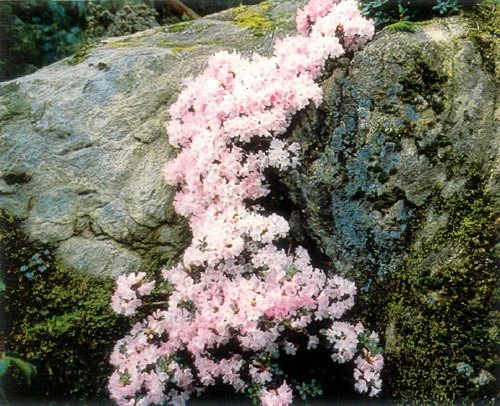
'Rose Elf' (R. racemosum x pemakoense)
Photo by Bill Dale
In his newer plantings Dave Dougan favour[ed] the small species, R. taliense especially. In the "overcrowded" field of hybrids ("a helluva lot of hybrids should never have been introduced"), he [grew] only outstanding newcomers that shaped up - mak[ing] what he call[ed] "mounders" - and flower[ed] profusely. His search for quality [was] consistent with his dictum: "If it's a good garden plant it's a good garden plant," a reminder that he is a gardener first and foremost. Mounders appear[ed] all over his giant volcanic mound and elsewhere: a strong pink R. campylogynum , R. pachysanthum , R. morii , R. yakushimanum grown from seed collected on the home island of Japan and exhibiting larger than normal foliage, R. metternichii , and a R. 'Carmen' seven feet broad. One mounder he [kept} close tabs on [was] a creation of H.L. Larson's R. yakushimanum x R. calophytum x 'Grisette', grown by ARS Gold Medalist Evelyn Weesjes and her husband Nick from seed obtained from Larson in 1968. "It's very nice," Evelyn [said]. "It has white buds, quite striking, different from an ordinary yak. The flowers start pinkish and turn white. Dave admired our plant, and that was his downfall." She named the cross 'Dave Dougan'* - a tribute also indirectly to Larson whose hybridizing he admire[d].
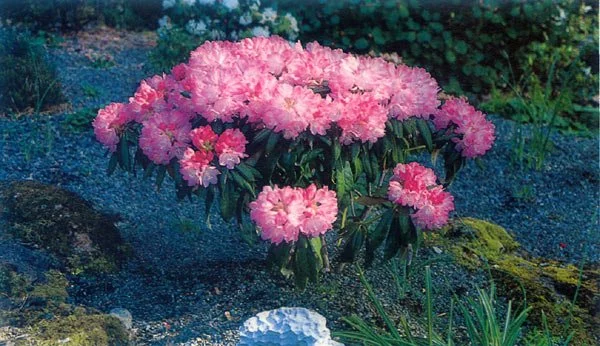
R. metternichii
Photo by Bill Dale
In the rhododendron pantheon gods abound, some smiling, some scowling. The creator is also the destroyer. In trying to make a bit of heaven on earth, gardeners obsessed with shrubs and trees learn to act the dual roles.
"The one thing you learn - the only thing you learn - is how short a time it takes for shrubs and trees to get completely out of hand. You have to be ruthless and get out the chainsaw. Some of the Rothschild and Lem hybrids become monstrous in a few years, and for that reason I don't grow them anymore. Last year I destroyed more rhododendrons than I planted. A simply beautiful 'Moonstone' from the Greigs, too big to move, had to go. I felt like a murderer, but I got back six other plants struggling to survive underneath. Every plant must have its place in the sun."
This, then, seems the secret of how the garden maintains a serene state of equilibrium, holding viewers rapt from one year to the next. "Dumb luck" did he say?
Leslie Drew, was a member of the Cowichan Valley Chapter
* Unregistered but not in conflict with a registered name.